Centrifugal Pumps: Flowrate inversely proportional to outlet pressure
Positive Displacement Pumps: Flowrate largely independent of the pressure
Pump Sizing:
Matching pump pressure and flowrate with system required flowrate and pressure. Pumps needs generate pressure high enough to overcome hydraulic resistance of the pipes, fittings, CV.
System Head: Static Head + Frictional Losses + Fitting Losses
- Amount of pressure required to achieve given flowrate in the system downstream of the pump.
- System head is not the fixed value. Higher the flowrate, higher the system head
- System Curve: Relationship between flowrate and hydraulic resistance of the system
- System head consists of
- Static head: Fixed value. Due to elevation difference between pump centerline and discharge
- Dynamic head: Varies dynamically with flowrate. Losses of energy due to friction in piping, fittings, change in fluid flow direction, opening of valves etc. It consists of Frictional losses + Fitting losses.
Dynamics losses ∝ Fluid Velocity
dP ∝ Q^2
Pump Curve:


Pump Hydraulic Power:
Power = Q.(ρ.g.h) = Q.dP
Power (W), Q(m3/s), others in SI unit
Pump Affinity Laws:
Law 1. With impeller diameter (D) held constant:
Law 1a. Flow is proportional to shaft speed:[1]

Law 1b. Pressure or Head is proportional to the square of shaft speed:
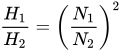
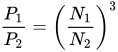
Law 1c. Power is proportional to the cube of shaft speed:
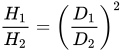
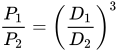
With shaft speed (N) held constant and for small variations in impeller diameter via trimming:
The volumetric flow rate varies directly with the trimmed impeller diameter:[3]

The pump developed head (the total dynamic head) varies to the square of the trimmed impeller diameter:[3]
The power varies to the cube of the trimmed impeller diameter:[3]
- These laws assume that the pump/fan efficiency remains constant i.e. , which is rarely exactly true, but can be a good approximation.

- NPSH

NPSHr:
Manufacturers test pumps under conditions of constant flow and observe the discharge pressure (differential head) as NPSH (the suction pressure) is gradually reduced. Tests are usually performed with water at 20°C. NPSH-R is defined as the value at which the discharge pressure is reduced by 3% because of the onset of cavitation (Figure 2). NPSH-R is sometimes shown as NPSH3 or NPSH3% to highlight this fact. For multistage pumps, only the first stage is taken into consideration for determining the 3% pressure drop.
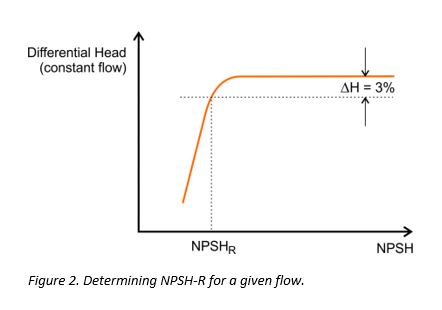
NPSH margin is typically 10% or 1 meter.


No comments:
Post a Comment